



You lined up your putt, read the slope, struck it beautifully… and the ball went sightseeing. Don't worry: it isn't your technique. It's sand, a few thousand neatly spaced little holes, and a handful of grass seed. The course at Domaine Ribiera has just been through its big annual appointment on the operating table: core aeration of the greens, followed by topdressing and overseeding. For a few days the course is a little unsettled. Here's why — and why you'll thank us this winter.
A green is a high-level athlete (that never complains)
A putting green is 4 to 5 millimetres of grass, mown almost every morning, walked on all day, watered, rolled, and expected to be firm, smooth and alive all at once. Beneath that perfect carpet, the soil compacts — exactly like the ground of a busy hiking trail. Air stops circulating, water sits on the surface, and roots that should reach down some fifteen centimetres huddle in the top three.
Then there is a quiet guest: thatch, a layer of organic debris that builds up between the grass and the soil and behaves like a sponge. A thatchy green is soft, slow, inconsistent and catches every disease going past. The cure comes in three steps, always in the same order.
1. Core aeration: we quite literally take cores out
A machine fitted with hollow tines travels across the green and pulls out small cylinders of soil — 8 to 15 mm across, 5 to 10 cm deep — every few centimetres. Several thousand per green. The result looks like a chessboard of tiny craters, and it is genuinely spectacular to watch.
Those holes are not a wound, they are chimneys: air travels back down to the roots, rain water passes through instead of pooling, the soil decompacts, and thatch is removed by volume rather than merely shaved off the top.
2. Topdressing: a miniature beach, then a permanent drain
Straight afterwards, a thin layer of specialist sand is spread and brushed until it disappears into every hole — hence the "mini beach" look for a few days. Unlike soil, sand does not compact: every filled hole becomes a permanent drainage channel. Season after season, that is how you rebuild a free-draining profile beneath a playing surface, and how greens end up firm, true and fast rather than spongy.
3. Overseeding: a few thousand new residents
A green that is open everywhere also makes the best seedbed of the year. So we sow: the seed drops into the holes, sheltered from wind, birds and spikes, surrounded by fresh sand and moisture. The sward thickens, the areas worn out by summer fill back in, and the finest grasses reclaim the ground that weeds had been nibbling at.
Why now, and not in February?
Because it has to grow back. In September the soil is still warm from summer, the nights turn cool again and the rain returns: it is the ideal window, the one in which grass grows fast and closes the holes within ten to twenty days. The same operation in midwinter would leave the green open until spring.
There is one more reason this year. The summer of 2026 and its heatwaves put turf across Haute-Provence under real strain: short roots, hardened soil, tired surfaces. This autumn aeration is precisely the care our greens needed to go into winter in good health — and come out of it beautifully green.
So can we still play?
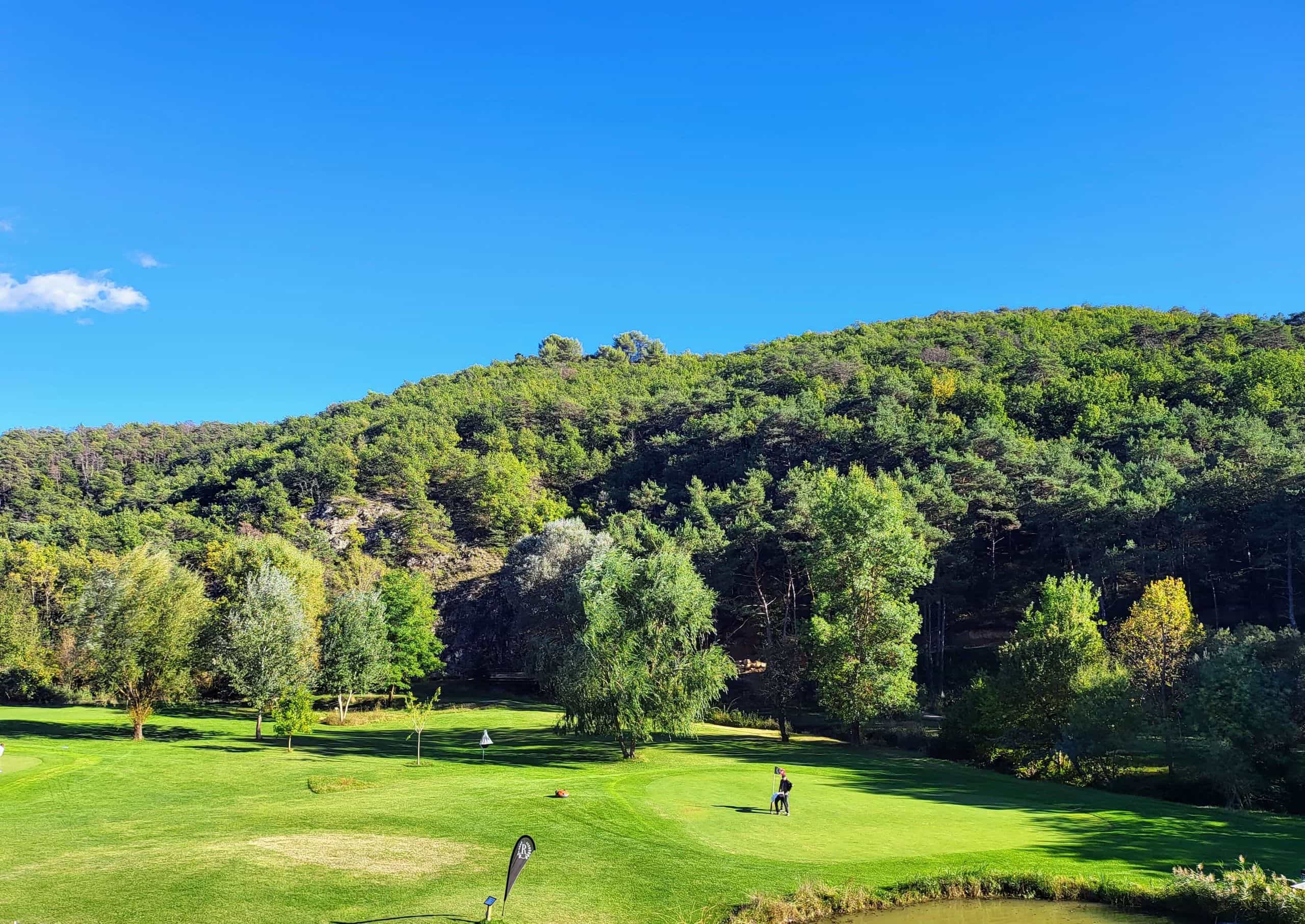
Of course. The 9-hole Pitch & Putt course stays open, and access remains included in your stay. It's simply that, for a few days, the natural greens are convalescing: the surface is sandy and the roll is whimsical. Our synthetic greens, however, are fully operational and take over: consistent roll, honest distances, not a grain of sand. The two-level driving range and the putting green are also at your disposal.
And since a local rule is called for: a putt that hops over a core is not a missed putt, it is an inconvenienced putt. It does not count. We are quite firm on this — at least until the end of the month.
What you will gain, very soon
Within two to three weeks the holes will have vanished, the sand will have been swallowed by the grass, and the greens will be firmer, faster and truer than before the operation. That is the price — willingly paid — of a course that stays green in January while others wait for spring.
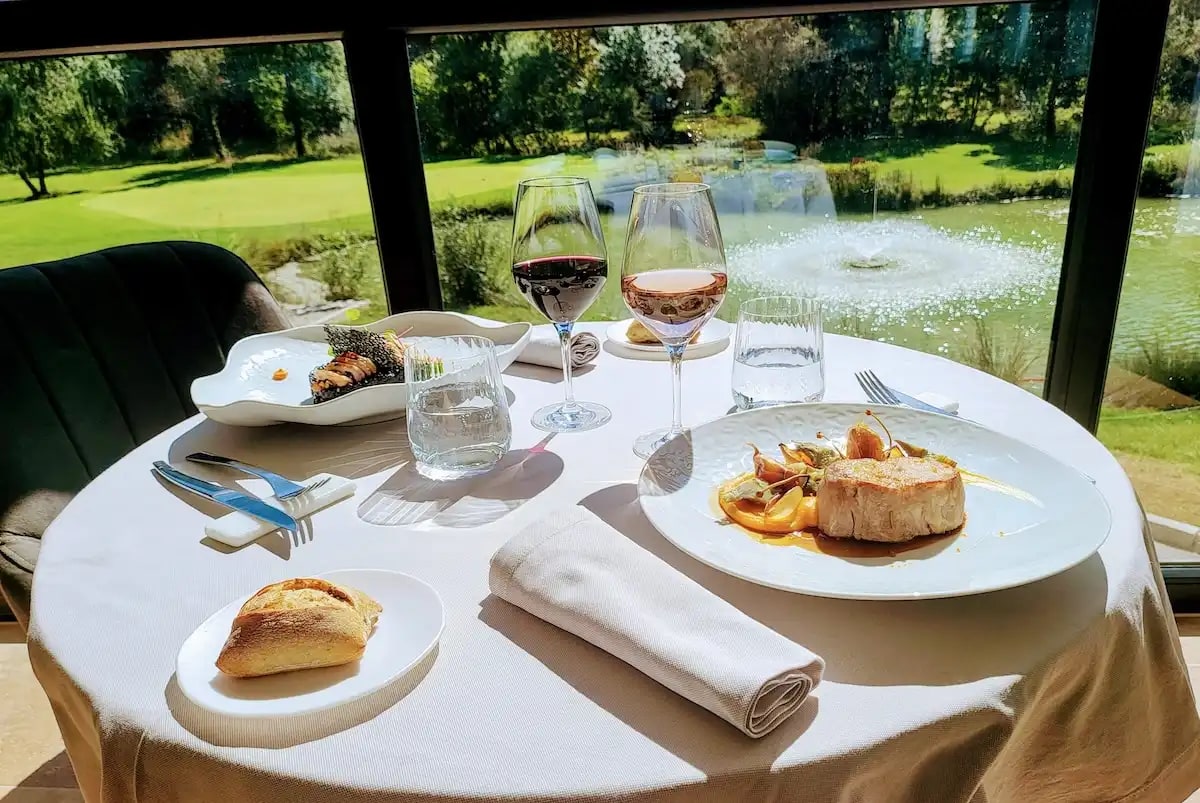
In the meantime, the perfect programme already exists: nine holes in the morning on the synthetic greens, lunch facing the course, then 1,300 m² of spa in the afternoon to forget your three-putts. See you on the course — and sorry about the sand.